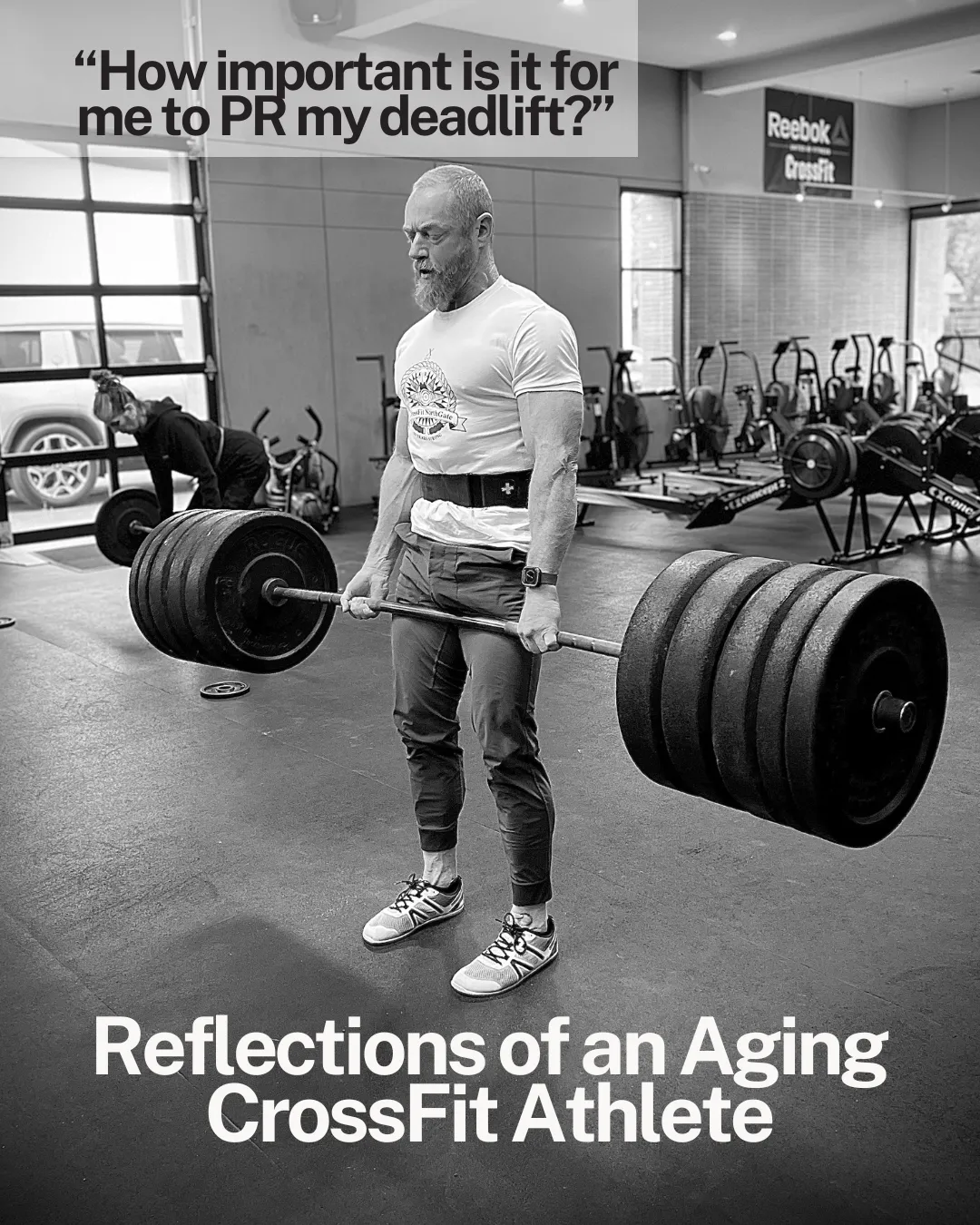
Reflections of an Aging CrossFit Athlete
Reflections of an Aging CrossFit Athlete
This month marks the start of my 18th year of CrossFit…and last week I was asked a question that made me stop and reflect:
“How important is it for me to PR my deadlift?”
A great question—and not one with a one-size-fits-all answer.
For this particular athlete, the deadlift is her strongest lift. She has pulled well over 300 lbs in the past, which is incredibly impressive. My answer to her? Not important.
She’s already close to her genetic ceiling for that movement. Unless she wanted to shift her entire training toward powerlifting, there’s only so much room left to push that number higher. And trying to squeeze out a few extra pounds comes with opportunity cost, especially when there are so many other areas of fitness that may not be as developed as her deadlift.
Checking the Boxes of Fitness
As we age, I like to think of our fitness journey as a series of boxes we work to check:
-Strength: Have you built truly solid, across-the-board strength? Check.
-Gymnastics fundamentals: Strict pull-ups, strict toes-to-bar, effortless pushups, strict HSPU? Check.
-Conditioning: Fast 400s, solid miles and 5Ks, and comfortable 10K+ efforts? Check.
-Movement quality: Excellent mechanics and mobility through full range of motion? Check.
-Body composition: Supported by nutrition, hydration, sleep, and stress management? Check.
Once you’ve hit these benchmarks, you’ve built elite fitness. You can (and should) continue improving, but your focus and intensity should evolve. We can only push so hard in so many directions at once. If the deadlift box is checked, it makes sense to concentrate more effort where things need to catch up. This doesn’t mean abandoning heavy lifting - it just means listening to your body and adjusting day to day based on what feels good.
Getting Fit vs. Staying Fit
Once you’ve built well-rounded fitness, you’re no longer “getting fit”—you’re staying fit. And staying fit is so much easier than getting fit.
This phase requires:
-More recovery
-More rest days
-More easy days
-Less constant pushing
This is where CrossFit can get tricky—especially for ex-athletes, type-A personalities, and fitness psychopaths (you know who you are). We love the push. We want to suffer. We crave the challenge. But there’s a cost.
My Own Ego Check
I’ve had to navigate declining performance in certain areas over the past few years. I grew up competing: high school sports, bike racing from age 16, a big chunk of my 20s and early 30s spent racing bikes and triathlons. I started CrossFit in my early 30s, at one point could snatch 265 lbs, and even finished top 40 worldwide (age group) in the CrossFit Open. That level of performance wasn’t sustainable long-term.
The loads, movements, and intensities I used to train at became problematic. Old injuries from my 20s popped back up. Ignoring those signals kept me in a perpetual state of tweaks and nagging issues. To keep going sustainably required a massive recalibration. The expectation that I should be stronger at 48 than I was at 38 is unrealistic given my training history.
I owe a lot to a long-time member, Adair Look, who introduced me to Stoic philosophy eight or nine years ago. She gave me books written by Marcus Aralius, Seneca and Ryan Holliday. And I arrived at this question that changed everything:
“Which of my decisions are driven by ego, and which align with my core values?”
It’s a useful lens for everything in life, but in fitness, it’s powerful. Here’s how that question might show up in a simple moment with a barbell:
If I’m sharing a barbell for snatches and the other person is stacking weight on, I can follow their jumps to “prove” I can still move heavy loads. That’s ego.
Or I can listen to my body - maybe my shoulders are tight from a week of bad mobility and snatches just don’t feel good today. From there, I might switch to cleans, mobilize after class, or stay lighter and add reps. Those choices support my core values: staying strong, staying healthy, and feeling good in my body.
Over time, this shift has worked.
I’ve maintained strength despite far less emphasis on lifting heavy. I’ve kept solid conditioning with far less all-out intensity. I still love CrossFit - even though I’m not competing - and even though I modify often. And while I’m less concerned about my performance relative to others, don’t get me wrong…I still love a good throwdown when it fits.
And you know what? With this process, sometimes I have days where I feel great and I surprise myself by hitting loads and intensities that I thought I’d never see again!
So What Does This Mean for You?
Every fitness journey is different, but I encourage you to ask yourself honestly:
What do I really want from my health and fitness?
If a massive deadlift is part of that vision -hell yeah! Come talk to me about chasing a PR. But you might find that being strong matters far more than the exact numbers. You might realize you’ve neglected the “unsexy” stuff - recovery, sleep, nutrition, mobility - and now is the right time to double down on those. You might realize that you’ve actually exceeded all of the fitness dreams that you ever had…and that’s great. Then, your fitness boxes are checked and all you have to do is show up at the gym to enjoy time with friends, and you’ll have lots of energy to put towards other aspects of life that can be improved.
And if your goal is to qualify for the CrossFit Games, win a 5K, or climb Everest, there is absolutely nothing wrong with that. We’re here to help you chase that version of your potential. I wouldn’t trade any of my competitive achievements. I learned a ton (good and bad) through those chapters. I encourage you to test your limits if it aligns with your current season of life, or kick back and enjoy the fitness that you’ve earned if that's what your life demands at this point.
But no matter where you are in your journey, keep asking: “Is this in line with my core values?”
If anything in this article resonates with you and you want help processing, setting goals, or figuring out your next steps, please reach out.
In ELITE fitness,
Coach Parker
