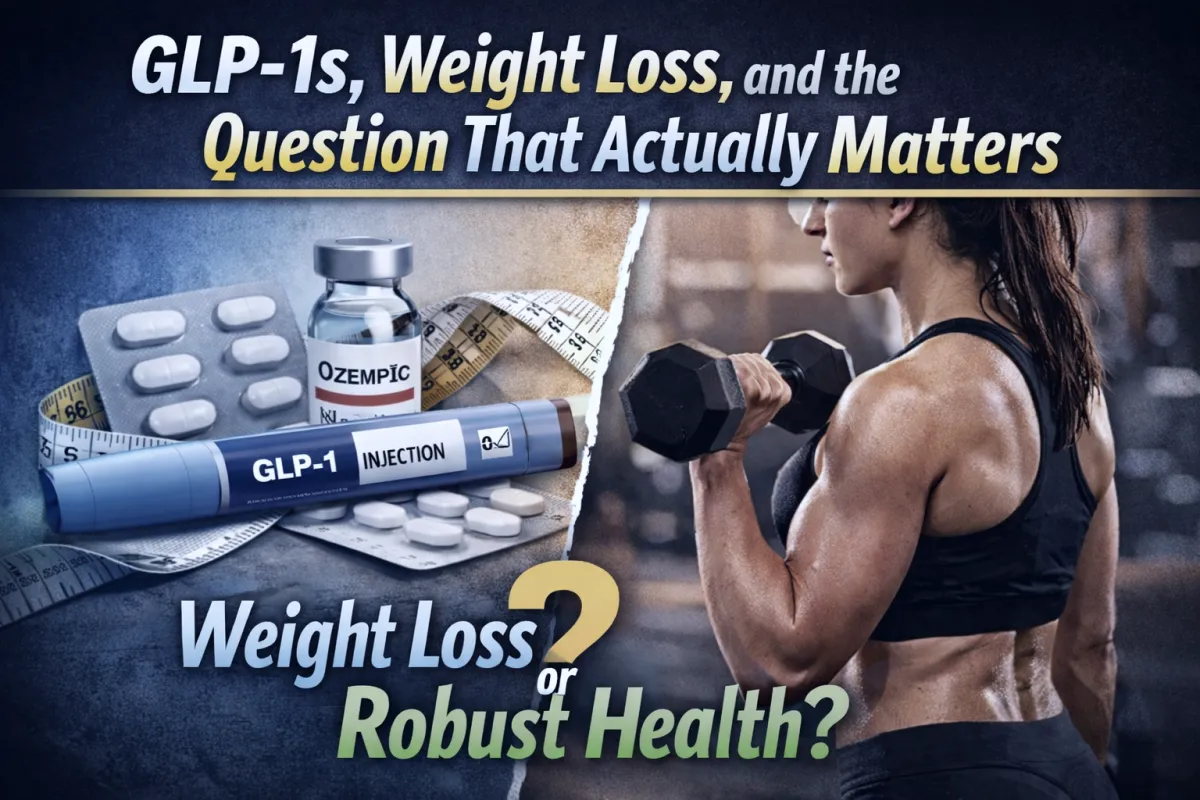
GLP-1s, Weight Loss, and the Question That Actually Matters
GLP-1s, Weight Loss, and the Question That Actually Matters
More and more I’ve been asked about my opinions regarding medications like Ozempic, Tirzepatide, and other GLP-1s, so I thought this would be a good topic to tackle head on.
I’m not a physician and won’t be dispensing medical advice. But after 28 years of fitness coaching, I do have a perspective that may be useful.
Let’s start with something important: They work.
For many people, these medications significantly reduce appetite, improve blood sugar regulation, and lead to meaningful weight loss. For individuals struggling with obesity, metabolic disease, or decades of failed dieting, they can feel life-changing.
This isn’t a post about shaming that. It’s a post about asking a better question. Should our focus be purely on weight loss, or is our ultimate objective to create robust health? Those are two very different goals.
From where I’m sitting, the real goal is to be healthier, stronger, more capable and resilient for the long term. To achieve these, a healthy body fat percentage is important.
These medications can produce significant weight loss. But weight loss is not automatically fat loss.
Without resistance training and adequate protein, a meaningful portion of that weight can come from lean mass. And that lean tissue, particularly muscle, is foundational to metabolic health, physical capacity, and how well we age.
That’s where this conversation gets more nuanced.
Where Weight Loss and Health Diverge
Weight loss and specifically fat loss can absolutely improve health markers. In large clinical trials of GLP-1 and dual GLP-1/GIP these medications are associated with:¹²
Significant reductions in body weight
Reductions in systolic and diastolic blood pressure
Improvements in triglycerides and other lipid markers
Improvements in fasting glucose and markers of insulin sensitivity
In trials involving individuals with type 2 diabetes, meaningful reductions in A1C have also been demonstrated.³
As body weight decreases, mechanical load on the feet, ankles, knees, hips, and spine declines substantially. This can reduce joint pain and improve mobility. Those are meaningful, evidence-based improvements.
But here’s the catch: weight loss is not the same thing as body recomposition. When weight drops rapidly, it does not come exclusively from body fat. Without resistance training and adequate protein, lean mass can be lost as well.⁴
That matters.
Because muscle is not just cosmetic. It is metabolically active tissue. It supports insulin sensitivity. It stabilizes and protects joints. It allows us to generate the mechanical loading that supports bone health. And it determines strength, work capacity, and independence as we age.
If someone loses 50 pounds and a meaningful portion of that comes from muscle, they are lighter, but not necessarily more resilient when it comes to long-term health.
As coaches, we constantly emphasise how important building and preserving muscle is for both short-term and especially long-term health. The health improvements that come with weight loss can be great, but the risk of losing muscle mass must be carefully considered.
The Real Risk Isn’t the Medication. It’s the Missing Structure.
I look at GLP-1s the same way I look at almost every tool in fitness. A tool is neutral. What determines the outcome is the system around it and the skill with which the tool is implemented.
If someone uses a GLP-1 while: strength training consistently, prioritizing adequate protein, focusing on nutrient-dense foods, walking daily and engaging in non-exercise movement, optimizing sleep and managing stress - then the medication may simply be helping them execute a healthier lifestyle more effectively.
That’s powerful leverage and hard to argue against as an effective tool.
But if the medication is used in isolation with no plan for muscle retention, no commitment to training, no attention to food quality, and no long-term strategy, then we may simply be suppressing appetite.
When coaching people around nutrition, one of the things that many find challenging is consistently eating enough protein. Protein is very satiating and when prioritized, it tends to curb appetite. If a medication like a GLP stunts appetite to the point where it becomes impossible to get enough protein - lean body mass will suffer.
Additionally, when we start to track fiber and micronutrients like vitamins and minerals - all essential to our health - undereating can pose a risk.
The Question That Actually Matters
Instead of asking: “Will this drug cause weight loss?”, a better question might be: “What does creating robust health really look like for me?”
Looking 6-month ahead, we might ask:
Am I stronger than when I started? More capable? Is my body composition better (fat mass to lean body mass ratio)? Am I sleeping well? Have my blood markers improved? Do I have more energy and vitality? Am I happier and more connected?
Or am I simply lighter?
It is entirely possible to be lighter and answer no to many of these questions.
Where We Stand at CrossFit NorthGate
We are not anti-medication. We are anti-fragility.
If a GLP-1 is medically appropriate and part of a thoughtful plan, the focus should be simple:
Protect muscle. Build strength. Improve capacity. Reinforce healthy habits. Make sure weight loss comes from fat - not lean tissue.
Resistance training becomes essential. Protein becomes non-negotiable. Nutrient dense foods must be prioritized.
If using a GLP-1 or if you’re considering one, the prescription should never be the entire plan. Training, nutrition, recovery, and accountability need to be part of the conversation.
If you’d like help building a comprehensive strategy - whether prescribed medication is part of it or not - reach out. We’ll create a plan that prioritizes long-term health, durability and vitality - not just a lower number on the scale.
In health,
Coach Parker
References
Wilding JPH, Batterham RL, Calanna S, et al.
Once-Weekly Semaglutide in Adults with Overweight or Obesity. New England Journal of Medicine. 2021;384:989–1002.
doi:10.1056/NEJMoa2032183Jastreboff AM, Aronne LJ, Ahmad NN, et al.
Tirzepatide Once Weekly for the Treatment of Obesity. New England Journal of Medicine. 2022;387:205–216.
doi:10.1056/NEJMoa2206038⁴ Dahl D, et al. Tirzepatide versus Semaglutide Once Weekly in Patients with Type 2 Diabetes (SURPASS-2). New England Journal of Medicine. 2022.
Garvey WT, et al. (STEP 1 Body Composition Substudy).
Changes in Body Composition With Semaglutide Treatment in Adults With Overweight or Obesity. Diabetes, Obesity and Metabolism. 2022.
(DXA analysis demonstrating proportion of lean mass lost during weight reduction.)
