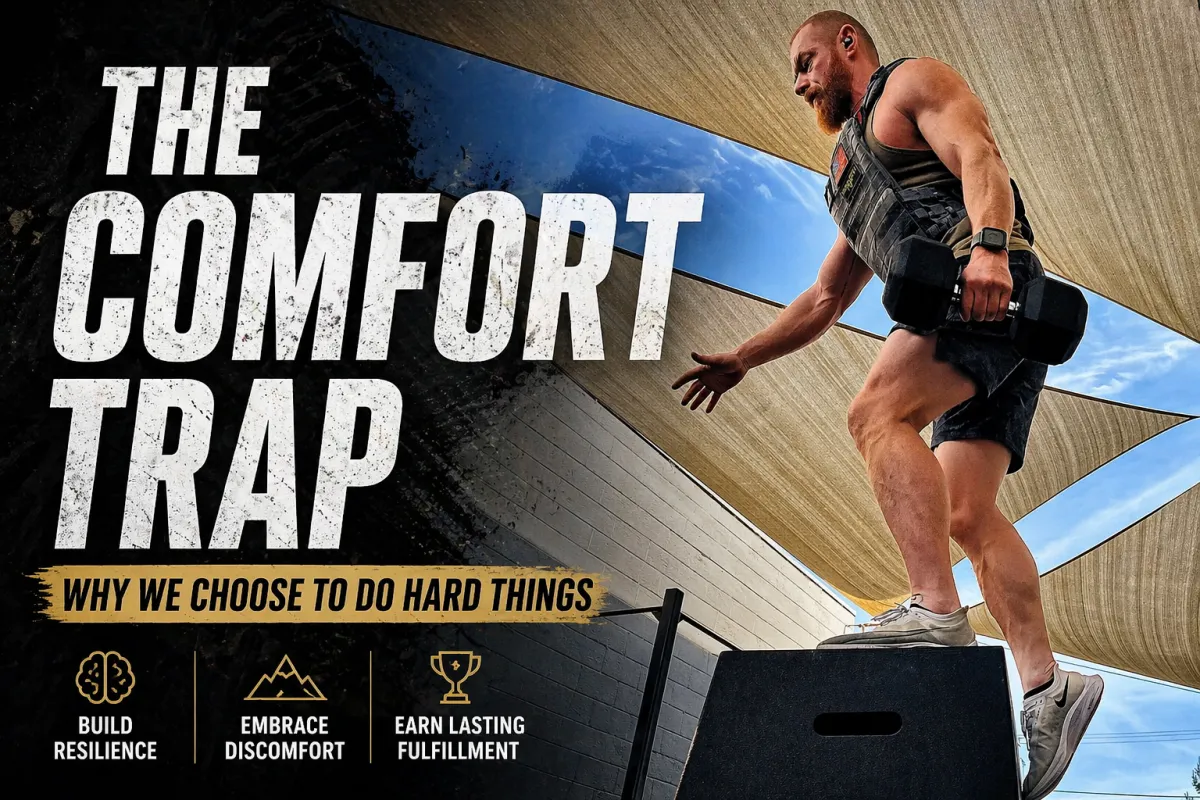
The Comfort Trap
Why we choose to do hard things...
For me, there almost always comes a point in a hard workout where that little voice in my head says: back off, take it easy, have a rest.
And that’s the point where I try to do the opposite - turn up the intensity, push through, and get it done.
Because if I step back and evaluate my fitness objectively, I probably have more than I need. I certainly have more than I need to live the comfortable life that our society serves up. But over time I’ve come to realize that the physical benefits are only one piece of what exercise actually provides.
There’s a reason that moment in a workout feels the way it does. Your brain can be wired to either avoid effort or lean into it, and part of that process involves a region called the anterior cingulate cortex, which plays a role in how we process discomfort and make decisions under pressure.
If we consistently avoid discomfort, our tolerance for it decreases. Effort starts to feel heavier than it should, resistance shows up earlier, and even small challenges can feel bigger than they actually are.
But the opposite is also true.
When you regularly choose to lean into discomfort - when you consciously choose the hard things that you don’t want to do - you grow that part of your brain. You become more comfortable being uncomfortable, and that changes not just how you train, but how you respond to challenges more broadly.
And if we’re being honest, the things that feel good in the moment rarely bring lasting satisfaction. The indulgences that offer immediate comfort tend to fade quickly, while the things that require effort: the workouts, the discipline, the challenges, are the ones that leave a more lasting sense of fulfillment.
I think that’s one of the most underrated benefits of training. It builds our tolerance for discomfort and reinforces, at a deeper level, the idea that the things in life that are hard are often the ones that are most worth doing.
Now depending on where you are in your fitness journey, your focus may still be primarily physical. You might be trying to lose weight, get off medication, or build strength and bone density. All of those are important and valid goals.
But even if that’s where you are right now, it’s worth recognizing that something else is happening at the same time. Every time you show up and do the work - especially when you don’t feel like it - you’re building the ability to keep going when things get difficult. Not just in the gym, but in other areas of your life as well.
And over time, something interesting happens. You start to build more fitness than you actually need. More strength, more endurance, more capacity than your day-to-day life requires. And that becomes a kind of safety net.
When life throws you a curveball - and it inevitably will - you have something to fall back on. You can afford to lose a little ground and still recover. You have reserves.
But more importantly, you’ve built the habits and the mindset to stay consistent through difficult seasons. When things get hard, you don’t abandon yourself or your priorities. And when that season passes, you can look back and know that you stayed committed, even when it would have been much easier not to.
That, more than anything, is why I train.
Not just for what it gives me physically, but for the kind of person it allows me to become.
And I see that play out in the gym every day—people who show up, do something hard, and then smile and laugh with each other afterward.
Keep showing up. Keep leaning into the hard stuff.
