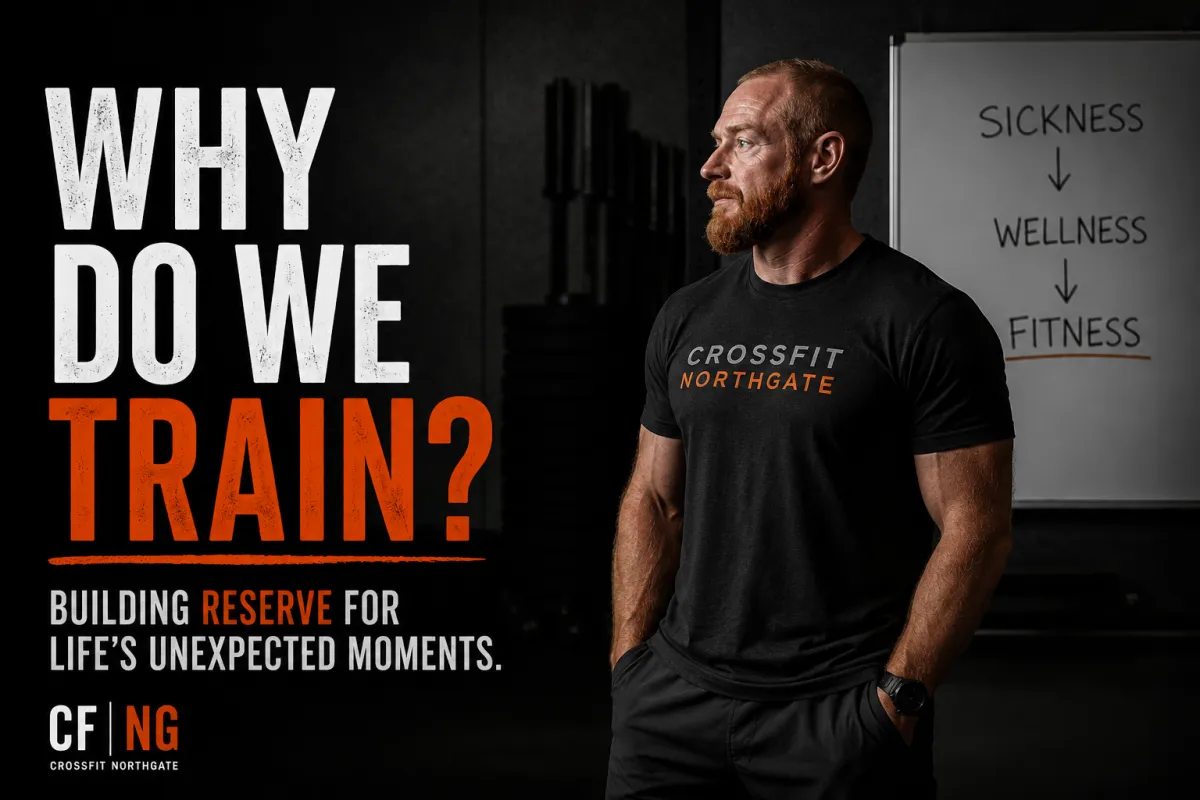
Why Do We Train?
Why do we train? How much strength, endurance, and conditioning is enough? At what point have we built all the fitness we'll ever need?
Almost 30 years ago, Greg Glassman began asking a similar question:
What is fitness?
That single question drove him to define it, measure it, test it, and ultimately build what became CrossFit.
If you've ever attended a CrossFit Level 1 Course, you'll know that before anyone talks about squats, pull-ups, or Olympic lifting, one of the first conversations is about defining fitness itself.
One of my favorite concepts from that lecture is the Sickness-Wellness-Fitness Continuum.
Imagine a line.
On one end is sickness. On the other is fitness. Between the two is wellness.
As we move from sickness toward wellness, we see improvements in measurable health markers like blood pressure, resting heart rate, blood sugar, triglycerides, body composition, and countless others. Continue moving in the same direction and those markers don't simply become "normal"—they become exceptional. This is where we typically find well-trained athletes.
The lesson is simple. Fitness isn't just the absence of disease. It's a physiological reserve beyond normal health.
For years, I appreciated that idea because it helped explain why CrossFit works. Today, I appreciate it for a very different reason.
When I was younger, fitness was about performance. I wanted to be faster, stronger, leaner, and more competitive. There was always another race, another PR, another milestone to chase.
Today, my perspective has shifted.
If I'm being honest, I probably have far more fitness than I need to get through an average day. I don't need to deadlift 400 pounds to carry groceries. I don't need to run a six-minute mile to walk with Shannon and the dogs. I certainly don't need muscle-ups to get out of bed in the morning.
So why keep training?
Because life isn't made up entirely of average days.
Every one of us will eventually face seasons that demand more than normal. An illness. An injury. Surgery. Caring for an aging parent. Helping a spouse through a difficult time. A stressful season at work. A new baby. A week with poor sleep. Even something as simple as moving into a new house.
Every one of those seasons temporarily reduces our capacity. Unable to invest in our health as diligently, we become a little weaker, a little slower, a little more fatigued, or simply have less time and energy to invest in ourselves.
If we've only built enough fitness to handle life when everything is going well, those inevitable challenges can push us toward the sickness end of the continuum remarkably quickly.
But if we've spent years building strength, endurance, muscle, healthy habits, and resilience, we've built something incredibly valuable.
We've built a reserve.
I think of fitness much like a savings account.
If you only have enough money to cover this month's bills, one unexpected expense can create a crisis. But if you've spent years building financial reserves, those same unexpected events become manageable.
Every workout is another small deposit. Every healthy meal, every walk, every good night's sleep, every decision to take care of yourself. None of them seem particularly significant on their own, but over time they compound into something incredibly valuable.
Over time those deposits create a reserve that you may not need today, but you'll almost certainly appreciate tomorrow.
This is one of the reasons I continue to train, and one of the reasons I encourage all of you to do the same.Not because I expect life to demand a 300-pound clean or a 50-inch box jump. But because I know it will eventually ask something difficult of me.
And when it does, I won't be operating at the edge of my capacity.
So why do we train?
To feel better. To look better. To perform better. Absolutely.
But over time, I think the answer becomes something even more meaningful.
We train so that when life inevitably becomes harder, we’re prepared. .
In health,
Coach Parker
