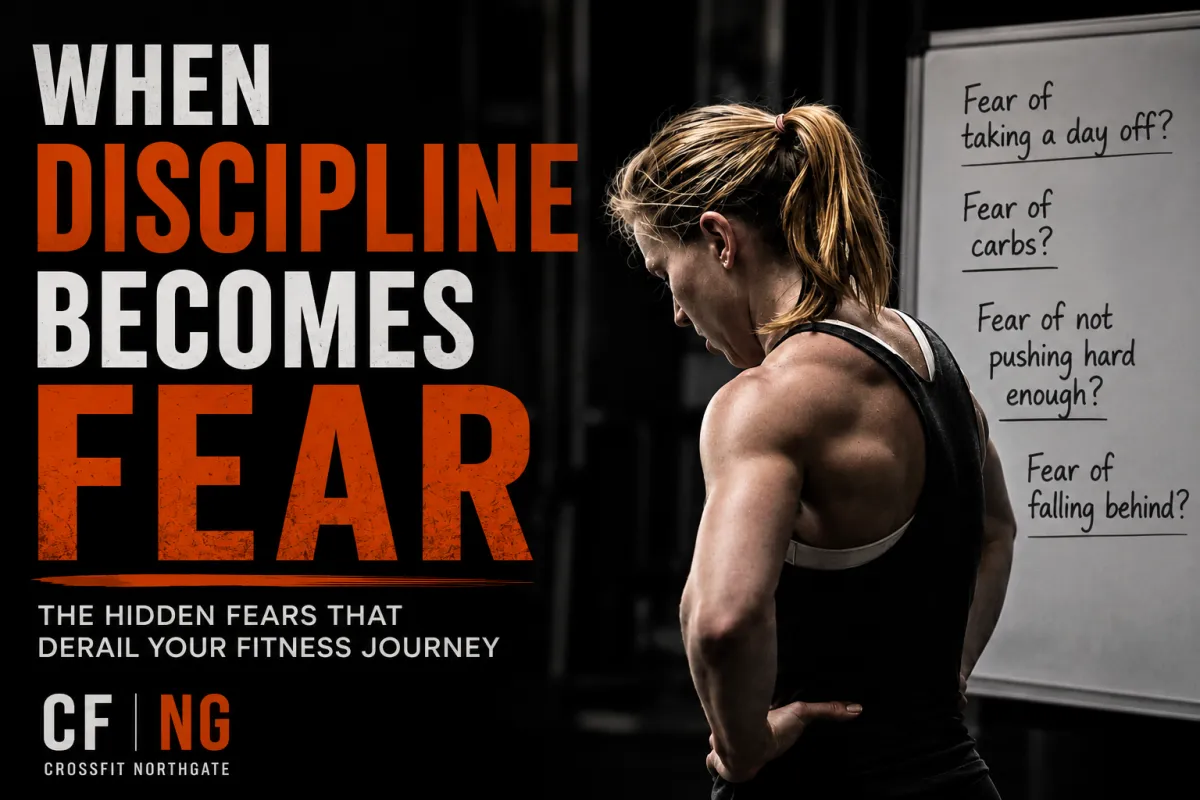
When Discipline Becomes Fear
When Discipline Becomes Fear
If there is one thing I've learned in the world of fitness that I believe 100%, it's this:
If you let fear drive your decisions, you will struggle.
Most people think about this from the obvious perspective. Don't be afraid to try something new. Don't be afraid to join a gym. Don't be afraid to lift something heavy, learn a new skill, or push yourself beyond your comfort zone.
And that's absolutely true.
Many people never realize their potential because they allow fear to stop them before they ever begin. They're afraid they'll fail. Afraid they'll look foolish. Afraid the results won't come quickly enough. Afraid they won't be able to sustain the effort.
But that's not the kind of fear I want to talk about today.
I'm talking about the fears that emerge later, after someone has already committed to the process. The fears that sneak in quietly and disguise themselves as discipline, dedication, or commitment.
Fear of taking a day off.
Fear of eating carbohydrates.
Fear of the number on the scale.
Fear of not pushing hard enough.
Fear of falling behind.
Fear of losing fitness.
I've seen these fears derail just as many people as the fear of getting started.
The problem is that they often look productive from the outside.
The athlete who never misses a workout is praised for their consistency. The person who avoids entire food groups is applauded for their discipline. The individual who refuses to back off despite exhaustion is admired for their toughness.
But underneath those behaviors, fear may be calling the shots.
One of the most important lessons I've learned over nearly three decades of coaching is that adaptation requires both stress and recovery.
Training is only half of the equation.
The workout itself doesn't make you fitter. The adaptation that occurs afterward is what creates progress.
The strongest athletes understand this. They know when to push and they know when to recover. They understand that rest is not weakness. It's part of the process.
The same principle applies to nutrition.
A healthy relationship with food is far more powerful than rigid rules driven by fear. Carbohydrates are not the enemy. Dietary fat is not the enemy. Enjoying dinner with friends is not the enemy.
Fear often convinces us that health exists at the extremes.
In reality, long-term success is usually found somewhere in the middle.
The healthiest and fittest people I know aren't the ones who are constantly trying to squeeze more out of every workout, eliminate more foods, or push harder than everyone else.
They're the ones who have developed enough confidence in the process to trust it.
They can take a rest day without guilt.
They can enjoy a meal without anxiety.
They can adjust training when life demands it.
They understand that a few days, weeks, or even months rarely determine the outcome. What matters is the accumulation of thousands of decisions over years and decades. If fear is driving your choices, it's worth asking yourself why.
Are you training because you love what it adds to your life? Or are you training because you're afraid of what might happen if you stop?
Are you eating a certain way because it makes you healthier? Or because you're afraid not to?
Fear is a useful emotion when it alerts us to real danger. But it is a terrible coach.
The goal isn't to eliminate fear completely. The goal is to recognize when it has quietly taken the wheel and replace it with something better: confidence in the process.
Because the best fitness journeys aren't built on fear. They're built on trust.
Trust that showing up consistently matters.
Trust that recovery is productive.
Trust that balance beats extremism.
And trust that your health can support your life, rather than control it.
In health,
Coach Parker
